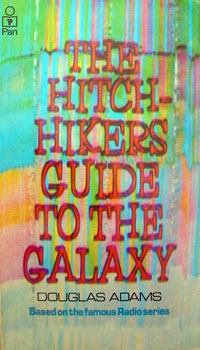
I ran across The Hitchhiker’s Guide to the Galaxy in high school and found it super entertaining. I won’t comment on how many years ago that was but I decided to re-read it recently. I love silly humor and have recently started watching silly movies with my teenage daughter so I decided it was time to read it again. Now I have to convince my daughter to read the book so we can walk around the house quoting it. In this blog, I will provide a summary of the book for those who may not have read it.
When Douglas Adams first unleashed The Hitchhiker’s Guide to the Galaxy (HHGTTG) upon the world in 1978—initially as a BBC radio series—no one could have predicted that a chaotic mix of British cynicism and cosmic absurdity would become a permanent pillar of pop culture. Decades later, it remains the definitive “trilogy in five parts” that reminds us just how ridiculous the universe really is.
A Terrible Thursday: The Plot Unfolds
The narrative kicks off on a perfectly normal, dreary Thursday. Arthur Dent, an unremarkable Englishman, wakes up to find bulldozers outside his home, ready to flatten it for a new road. He is rescued from this domestic crisis by his friend Ford Prefect, who reveals two life-altering secrets: first, he is an alien from a small planet somewhere in the vicinity of Betelgeuse; and second, the Earth is about to be destroyed in approximately twelve minutes.
The culprits are the Vogons, a race of bureaucrats so unpleasant they wouldn’t even save their own grandmothers from the Ravenous Bugblatter Beast of Traal without orders signed in triplicate. As the Earth is vaporized to make way for an intergalactic highway, Ford hitches a ride for himself and Arthur onto the Vogon demolition ship.
What follows is a breakneck journey through the stars. After being tortured by Vogon poetry (the third worst in the universe) and ejected into the vacuum of space, they are picked up by the Heart of Gold. This ship is powered by the Infinite Improbability Drive, a device that makes the impossible happen—like turning a pair of nuclear missiles into a bowl of petunias and a very surprised sperm whale.
On board, Arthur encounters a bizarre cast of characters:
- Zaphod Beeblebrox: The two-headed, three-armed, narcissist President of the Galaxy who stole the ship because he thought it would be fun.
- Trillian: The only other human survivor, whom Arthur once unsuccessfully tried to chat up at a party in Islington.
- Marvin: A GPP (Genuine People Personality) robot suffering from severe clinical depression.
The plot eventually leads them to the legendary lost planet of Magrathea, where they discover that the Earth was actually a giant organic supercomputer built to find the “Ultimate Question.” As it turns out, the mice (who are actually hyper-intelligent pan-dimensional beings) were the ones running the experiment all along.
The Philosophy of the Absurd
What sets Adams apart from his sci-fi contemporaries is his mastery of the absurd. While other writers were busy speculating on the physics of warp drives, Adams was busy explaining why the most important thing a space traveler can carry is a towel.
He pioneered a specific brand of “technological bathos”—the idea that no matter how advanced a civilization becomes, its tech will still be glitchy, its bureaucracies will still be soul-crushing, and its robots will still be depressed. Take Marvin, the Paranoid Android. In a genre usually populated by sleek, helpful AI, Marvin is a genius-level robot with “a brain the size of a planet” who is perpetually bored and miserable. He is the ultimate antidote to the shiny, optimistic futurism of the mid-20th century.
The Guide as a Cultural Oracle
The Guide itself—the electronic book within the book—was a startlingly prophetic concept. Long before we had Wikipedia, smartphones, or Kindles, Adams envisioned a handheld device that contained the sum of all knowledge (much of it redacted or outright wrong) and was popular because it was slightly cheaper than its competitors.
The two words inscribed on its cover in “large, friendly letters” have become a mantra for generations: DON’T PANIC.
It’s a piece of advice that transcends the book. In a world that feels increasingly volatile and nonsensical, “Don’t Panic” is a radical act of defiance. It suggests that while the universe is big, scary, and indifferent to your existence, there’s no point in letting it ruin your day.
The Answer to Life, the Universe, and Everything
Of course, we can’t talk about HHGTTG without mentioning the number 42.
The revelation that a supercomputer named Deep Thought spent 7.5 million years calculating the “Ultimate Answer” only to produce a meaningless two-digit integer is Adams’ greatest joke. It’s a satirical jab at our obsession with finding a “point” to existence. The joke isn’t that the answer is wrong; it’s that we haven’t a clue what the actual question is.
“I’d trust high-speed computers with my life, but I wouldn’t trust them with my lunch.” — Douglas Adams
Why It Still Matters in 2026
You might think a book written in the late 70s would feel dated, but Adams’ themes are more relevant than ever. We live in an era of “Babel Fish” style instant translation and a constant deluge of information that often feels as chaotic as the Guide itself.
Adams’ writing reminds us to maintain a sense of humor in the face of the infinite. He suggests that the universe isn’t a grand, orchestrated masterpiece, but rather a series of happy (and unhappy) accidents.
Essential Lessons from the Galaxy:
- Perspective is everything: The “Total Perspective Vortex” proves that seeing your true insignificance is enough to break your mind—unless you’re Zaphod Beeblebrox.
- The importance of the mundane: In the face of galactic destruction, Arthur Dent’s biggest concern is often a good sandwich or a hot drink.
- Bureaucracy is universal: Whether it’s the Vogons or your local council, some things never change.
Final Thoughts
Douglas Adams didn’t just write a comedy; he wrote a survival manual for the modern age. The Hitchhiker’s Guide to the Galaxy teaches us that if the world is going to end to make way for a bypass, you might as well grab your towel, hitch a ride, and see where the stars take you.
Just remember: whatever you do, don’t let them read you any poetry.
 Ryburn.org
Leave a comment