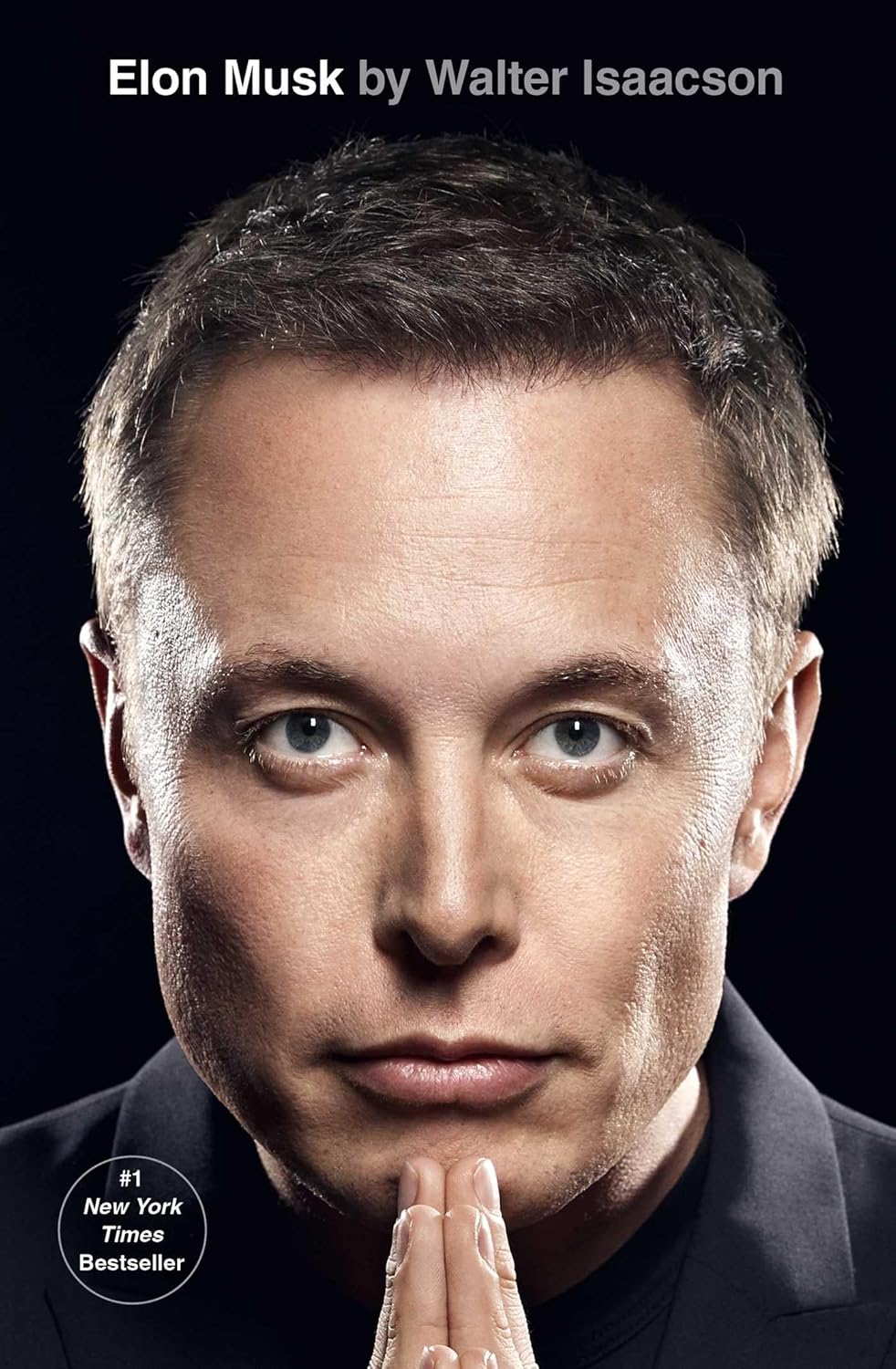
The Demon and the Dynamo: Unpacking Walter Isaacson’s Elon Musk
A number of years ago I read Walter Isaacson’s chronicle of the life of Steve Jobs. When a co-worker told me Isaacson had shadowed Elon Musk and written a biography, I knew it was something I need to check out. The result, simply titled Elon Musk, is a sprawling, 680-page psychological deep dive that attempts to answer a singular, uncomfortable question: Can the world-changing innovation Musk produces be separated from the volatile, often “demon-mode” personality that drives it?
Isaacson doesn’t just write a biography; he provides a “decoder ring” for the most polarizing figure of the 21st century.
The Architecture of a Turbulent Mind
The book begins not in a Silicon Valley boardroom, but in the brutal schoolyards of Johannesburg and Pretoria. Isaacson paints a visceral picture of a young Musk being shoved down concrete steps and beaten until his face was a “swollen ball of flesh.” However, the author argues that the physical scars were nothing compared to the emotional ones inflicted by his father, Errol Musk—a man Isaacson describes as a “Jekyll-and-Hyde” figure who would berate his son for hours.
This childhood trauma as rocket fuel is the book’s central thesis. Isaacson posits that Musk never truly escaped that survival mode. Instead, he developed a craving for drama and a maniacal sense of urgency”that defines his leadership style today. When things are going too well, Isaacson observes, Musk becomes restless and creates a crisis—a “surge”—to keep the adrenaline pumping.
“Demon Mode” and the Hardcore Philosophy
One of the most talked-about revelations in the biography is the concept of “Demon Mode.” Coined by Musk’s former partner Grimes, the term describes a state where Musk becomes ice-cold, hyper-focused, and frequently cruel to those around him. Isaacson recounts numerous scenes where Musk berates engineers or fires employees on a whim because they don’t meet his “hardcore” standards.
Isaacson details Musk’s management “Algorithm,” a five-step process for production that includes:
- Question every requirement.
- Delete any part or process you can.
- Simplify and optimize.
- Accelerate cycle time.
- Automate.
This ruthless adherence to first principles allowed SpaceX to build reusable rockets and Tesla to revolutionize the electric vehicle industry when experts said both were impossible. But as Isaacson notes, the human cost is high. Musk has little empathy for those seeking work-life balance, famously stating, “A maniacal sense of urgency is our operating principle.”
The Multi-Front War: From Mars to X
The biography spans the sheer breadth of Musk’s empire—SpaceX, Starlink, Tesla, Neuralink, xAI, and The Boring Company—but it finds its climax in the chaotic acquisition of Twitter (now X). Isaacson was “in the room” as Musk paced the floors, agonizing over the purchase and eventually “unplugging” servers himself in a late-night fit of impulsivity.
Isaacson frames the Twitter saga as Musk’s attempt to defeat the “woke mind virus,” which Musk believes is a threat to human consciousness. The book doesn’t shy away from the messiness: the botched launches, the fluctuating stock prices, and the geopolitical weight Musk carries via Starlink. One notable section discusses the controversy over Starlink in Ukraine, where Musk’s personal decisions directly impacted the front lines of a global conflict—highlighting the terrifying reality of a private citizen wielding the power of a nation-state.
Is the Genius Worth the Chaos?
Isaacson’s writing style is famously “fly-on-the-wall.” He presents the facts with a cool, journalistic detachment that has drawn both praise and criticism. Some reviewers argue he is too lenient, acting as a “stenographer for a billionaire,” while others appreciate that he lets the reader play judge and jury.
“Are the demons that drive Musk also what it takes to drive innovation and progress?”
This is the question Isaacson leaves hanging. He suggests that if you “filtered out” the impulsivity, the lack of empathy, and the thirst for risk, you might lose the person who forced the world into the era of electric cars and private space travel.
Final Thoughts
Elon Musk by Walter Isaacson is an essential read, not just for “fanboys” or “haters,” but for anyone trying to understand the intersection of technology, power, and personality. It portrays Musk as a man-child with the toys of a god—a figure who is simultaneously saving the world and setting it on fire, often just to see what happens.
Isaacson doesn’t ask us to like Elon Musk. He asks us to look at the “machine that builds the machine” and decide if the output justifies the input. In a world increasingly shaped by Musk’s whims, the answer to that question is more important than ever.
 Ryburn.org
Leave a comment