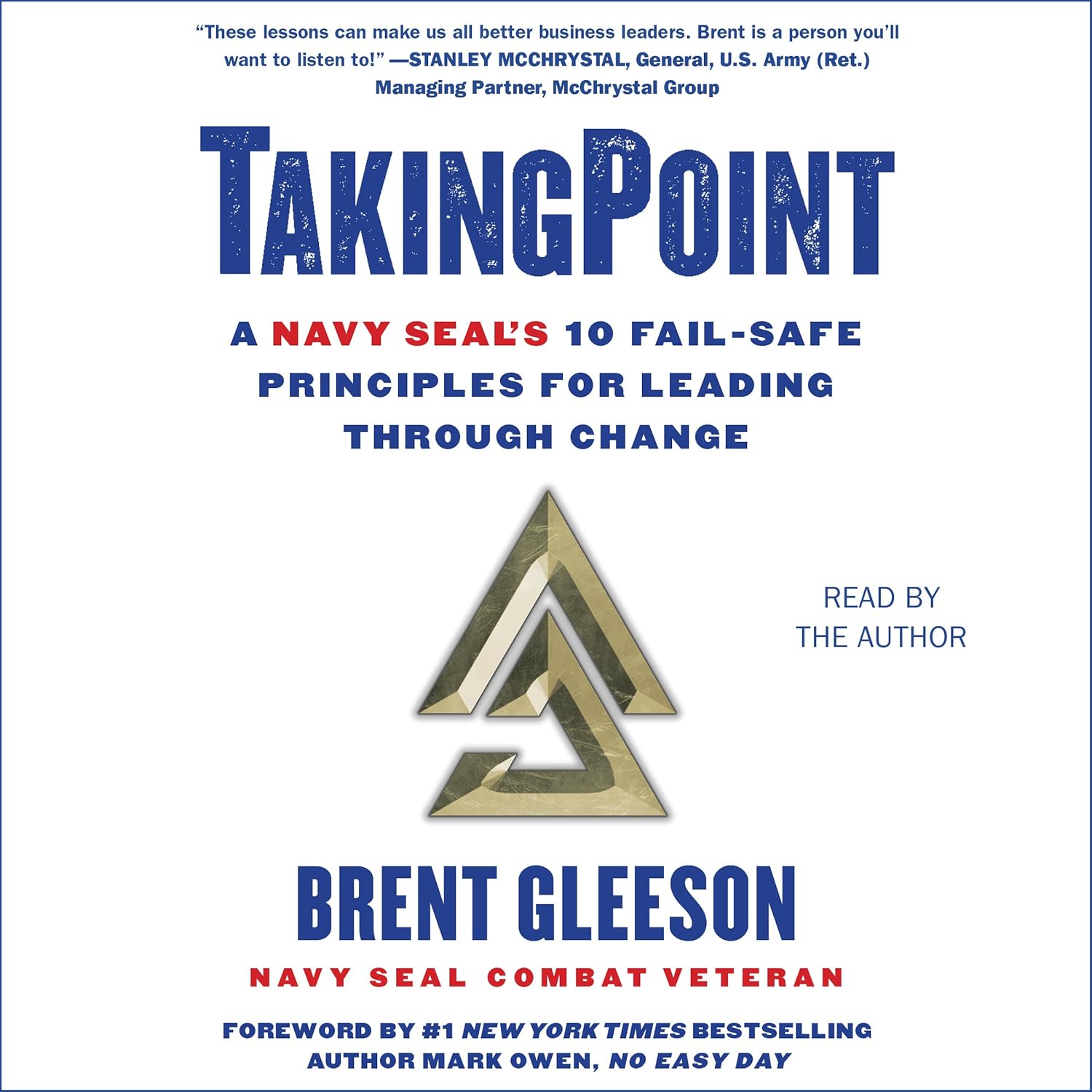
Key Lessons from Brent Gleeson’s Taking Point
In modern business, “change” isn’t just a buzzword; it’s the only constant. Whether it’s a sudden market shift, a technological disruption, or an internal restructuring, organizations are perpetually in a state of transition. Yet, despite the frequency of change, most companies fail at transformation.
Brent Gleeson, a former Navy SEAL turned entrepreneur, argues that the reason for this failure is a lack of resilient leadership and accountability. In his book, Taking Point: A Navy SEAL’s 10 Fail-Safe Principles for Leading Through Change, Gleeson bridges the gap between battlefield tactics and boardroom strategy. He provides a high-octane roadmap for leaders who want to transform their organizations into elite, adaptable teams. As frequent readers know, I read Gleeson’s book Embrace the Suck. I enjoyed it so much I had to check out this one. This blog is a review along with my key findings from the text.
The SEAL Approach to Business
The core premise of Taking Point is that the principles used to forge the world’s most elite special operations units are directly applicable to the corporate world. In the SEAL teams, “taking point” means being the person at the front of the file—the one navigating the path, identifying threats, and bearing the highest risk.
Gleeson suggests that in business, every leader must be willing to take point. Change fails when leadership remains in the rear, issuing orders without getting their hands dirty. Here are the ten fail-salfe principles of the Taking Point philosophy.
The Foundation: Culture, Trust, and Accountability
The core premise of Taking Point is that you cannot lead change if the ground beneath you is shaky. Gleeson identifies the first three principles as the “bedrock” of any successful transformation.
First, Culture is the primary driver. Gleeson famously notes that culture eats strategy for breakfast. If your team doesn’t share a common “why,” the best strategy in the world won’t save you. This is supported by the second principle, Trust. In the SEAL teams, trust is the currency of survival. In business, it’s the currency of speed. When trust is high, communication is instant and clear; when it’s low, every decision is bogged down by politics.
Finally, there is Accountability. Gleeson advocates for “Total Accountability,” where every member of the team takes 100% ownership of the mission’s outcome. When a leader admits their mistakes openly, it creates a safe environment for others to do the same, leading to faster course corrections.
The Preparation: Mindset, Prep, and Transmission
Once the foundation is set, a leader must prepare the team for the “battle” of reorganization. This begins with Mindset. Gleeson argues that a team must move from a “fixed” mindset to a “growth” mindset, viewing obstacles as tactical problems to be solved rather than reasons to quit. Gleeson share stories from SEAL training where they do After-Action Reviews (AAR) to continually improve their strategy and mission approach. I’ll talk more about this in a future section.
This leads directly into Preparation. In the SEALs, for every hour spent on a mission, dozens are spent in preparation. For business leaders, this means identifying risks and contingencies before the first move is made. However, preparation is useless without Transmission. This principle is about over-communicating the mission. If your frontline employees can’t explain the goal in one sentence, your transmission has failed.
The Execution: Inclusion, Fatigue, and Discipline
As the change initiative begins, leaders often encounter the “Valley of Death”—the phase where excitement wanes and results haven’t yet surfaced. To navigate this, Gleeson introduces Inclusion. By involving the team in the planning process, you ensure buy-in. People are far more likely to support a “plan” they helped create.
Execution also requires a keen eye on Fatigue. Change is exhausting. Leaders must manage the emotional and physical energy of their teams to prevent burnout. This is balanced by Discipline—the ability to stay focused on the core objectives and avoid “shiny object syndrome” when the pressure mounts.
The Result: Resilience and the After-Action Review
The final principle is Resilience. This is the ability to bounce back from the inevitable setbacks that occur during a transition. But resilience in the Taking Point model isn’t just about “toughing it out”; it’s about learning.
Continuous improvement is a hallmark of elite teams. The SEALs use the After-Action Review (AAR) after every single mission. They sit in a room, leave their egos and ranks at the door, and ruthlessly analyze what went right and what went wrong. Gleeson encourages businesses to adopt this ritual. Instead of waiting for an annual review, conduct “debriefs” after every major milestone. The goal isn’t to punish; it’s to ensure the same mistake is never made twice. A big part of the success of this is making sure that all voices are heard, no matter their title in the organization.
Leading Through the Fog
The “fog of war” is a term used to describe the uncertainty of the battlefield. In business, this fog consists of data overload, competitor moves, and economic shifts. Gleeson’s message is clear: You cannot wait for perfect information to act.
Waiting for 100% certainty leads to paralysis. Taking Point teaches leaders to move with 80% certainty, knowing that their team is agile enough to pivot as new information emerges. This “bias for action” is what separates market leaders from those who are left behind.
Conclusion
Brent Gleeson’s Taking Point is more than a leadership book; it’s a call to arms for anyone tired of the status quo. It challenges leaders to stop managing and start leading. By focusing on culture, decentralized command, and radical accountability, you can build a team that doesn’t just survive change—it thrives on it.
In the end, taking point is a choice. It’s the choice to lead from the front, to embrace the discomfort of growth, and to forge a team that is “ready to lead and ready to follow, and will never quit.”
 Ryburn.org
Leave a comment