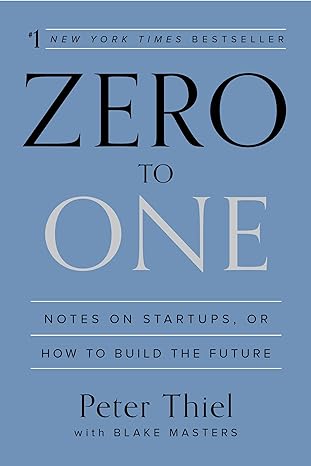
Zero to One: Notes on Startups, or How to Build the Future
These days a lot of startups are building “me too” products or making incremental improvements. Peter Thiel’s Zero to One: Notes on Startups, or How to Build the Future offers a provocative and essential counter-narrative. Far from a typical business how-to guide, Thiel’s book, co-written with Blake Masters, challenges conventional wisdom, urging entrepreneurs and innovators to pursue radical new ideas rather than simply optimizing existing ones. At its core, Zero to One is a manifesto for genuine innovation, a call to build the future by creating truly new things, moving from “zero to one,” instead of just copying successful models and going from “one to N.”
The Crucial Distinction: Horizontal vs. Vertical Progress
Thiel, a co-founder of PayPal and Palantir, and an early investor in Facebook, brings a wealth of firsthand experience and a unique, often contrarian, perspective to the table. His central thesis revolves around the distinction between horizontal and vertical progress. Horizontal progress, or globalization, involves copying things that work across the world, taking something from one to N. Think of China manufacturing everything the U.S. does, just cheaper. Vertical progress, on the other hand, involves doing new things, going from zero to one. This is innovation. This is the act of creation. It’s the difference between building new factories around the world and inventing a new type of manufacturing process altogether.
The Power of Monopoly: Why Competition Isn’t Always Good
The book delves into the critical importance of creating monopolies, a concept that often raises eyebrows in a free-market society. Thiel argues that true innovation naturally leads to a temporary monopoly, not through illegal collusion, but through creating something so uniquely valuable that it has no real competition. If you have to compete, you’re not doing something new enough. Think of Google in its early days, or even today in search. They weren’t just a slightly better search engine; they were orders of magnitude better, creating a new paradigm. This type of monopoly, he asserts, is the engine of progress, allowing companies to invest in long-term research and development without the constant pressure of price wars and short-term thinking.
Uncovering Secrets: The Foundation of Breakthroughs
Thiel champions the idea that successful companies are built on secrets – fundamental truths about the world that few people agree with you on. These secrets can be about technology, human behavior, or market dynamics. The act of founding a company, then, becomes the process of uncovering and acting upon such a secret. If there were obvious answers to all the world’s problems, they would have already been solved. Therefore, true innovation requires looking for those hidden truths, those unconventional insights that can unlock unprecedented value.
Definite Optimism: Building the Future with Intent
One of the book’s most compelling chapters explores the “myth of the constantly changing future” and the importance of definite optimism. Thiel distinguishes between indefinite optimism, where the future is expected to be better but without a clear plan, and definite optimism, where people believe they can actively build a better future. Silicon Valley, he suggests, often falls into the trap of indefinite optimism, focusing on iterating on existing ideas rather than pursuing bold, ambitious visions. He champions the latter, advocating for a clear, well-defined plan for creating a specific future, rather than simply reacting to trends.
The Founder’s Role and Niche Markets
Thiel also challenges the conventional wisdom that founders are interchangeable or that a great idea is enough. He stresses the critical role of a strong, almost idiosyncratic, founder – someone with a unique vision and the ability to inspire and lead. The PayPal “mafia” is a prime example, where a group of highly talented individuals with a shared experience went on to found or invest in numerous other successful ventures. This highlights the importance of strong team dynamics and shared purpose in building a successful enterprise.
Furthermore, Zero to One emphasizes the importance of going after niche markets first. Rather than trying to conquer a massive market from day one, Thiel suggests starting with a small, underserved segment where you can achieve a dominant position. Once you’ve established that foothold, you can then expand into larger adjacent markets. This “monopoly by design” strategy minimizes competition and allows a startup to build momentum and resources before facing broader market pressures.
A New Way of Thinking
In essence, Zero to One is not a book about how to build a successful startup by following a template. It’s a book about how to think differently, how to question assumptions, and how to create something truly new. It’s a challenging read that forces you to re-evaluate your understanding of innovation, competition, and the nature of progress. For anyone aspiring to build a company that genuinely changes the world, or for those simply seeking a deeper understanding of what drives true innovation, Zero to One is an indispensable guide, a call to embrace the difficult but ultimately rewarding journey from zero to one. It’s a book that doesn’t just offer advice; it offers a new way of seeing the future, and more importantly, a new way of building it.
 Ryburn.org
Leave a comment